
At the time I didn’t see my decision to quit softball as copping out or giving in, as much as resigning myself to “growing up,” which somehow translated to acting more feminine. It was the same depressed feeling I’d get as a young kid when I looked at the 1950s moms wearing their stupid sundresses with matching lipstick and joylessly assumed that someday, when older, I’d have to dress like that, too.
How could I give up sports, though? I concluded I just needed to find something more socially acceptable. In 1971, only tennis seemed to fit the bill. People didn’t ridicule female tennis players or roll their eyes in disapproval. These girls somehow slipped under the judgmental radar.
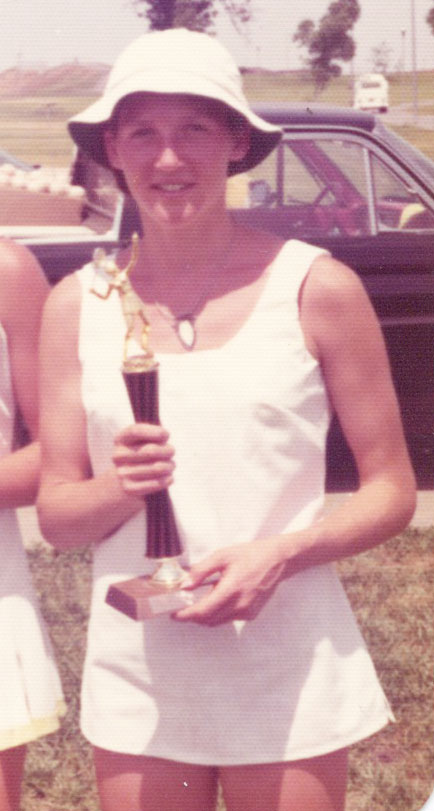
Coach Sanders, then close to seventy, accepted me as a student conditionally, explaining that he was cutting back and only taking players that he felt had pro potential. Age spots and lesions from a lifetime of cooking himself on hot, outdoor courts covered his dry, leathery skin, but I liked his serious, spartan manner.
Within a few months he entered me in a few novice tournaments, which I won. At my next lesson he called me over for a serious talk.
“You’re coachable, you have drive and determination, and you’re athletically gifted. I think you can make the pros, but you can expect it to take eight to ten years. Are you willing to make that kind of commitment? Would you like me to be your coach?”
Wow, how exciting. I nodded my head, of course! Then he continued.
“I’d be willing to take you on, if you will be my girlfriend.”
Dumbfounded, I stared at the face of my tennis racket as he continued speaking. The crisscross weave of gut strings blurred then focused, blurred then focused, and his words reached my ears oddly muted, as if arriving across a very long distance.
“You see, I’m married and love my wife,” he explained in a matter-of-fact tone, “but she’s an invalid now, and I still have physical needs. I have one other student who, like you, could go pro: Maria Alvarez, but she’s Mexican. You think about it, and you let me know.”
As I’ve said, my sexual awareness in this period—even at seventeen years old—was minimal to non-existent. By that point, having traveled with my semi-pro softball team for three summers, I now knew that most of the Wildcat players had female girlfriends and I understood that women who preferred women more than men were called lesbians. I also knew that some of my high school girlfriends were already physically active, and they reported feeling “horny” and enjoying sex with boys—the idea of which appalled me. Grody, why? I’d even attended parties at which boys had wanted to fondle me and “ball,” the even-then-disgusting 70s term for having sex. I declined. Despite all this exposure to sexuality, I had not yet myself experienced any inkling of physical arousal, so all my “worldly knowledge” had no actual, concrete meaning to me.
On some level I understood Coach’s offer: he wanted me to have sex with him in exchange for eight to ten years of free professional coaching. In addition to being bothered by his blatant racism—that I was more suitable/desirable than a Mexican—the sexual proposition, so bluntly laid forth, repulsed me. I couldn’t bear the thought of sexually touching anyone, let alone that dried-up, old pervert!
 How the Ball Bounced, by Nancy Nerenberg