Published as “There Is No Good Decision” on April 20, 1997
West Magazine, San Jose Mercury News
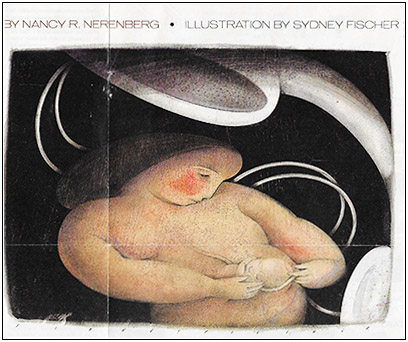
Often, particularly among women, the subject of children and pregnancies comes up. Depending on how well I know the person, or on how I’m feeling at the moment, I will share that I had a pregnancy between Maya and Miles. Sometimes I will say that I “lost” the pregnancy. Sometimes I’ll imply that I “miscarried.” And occasionally I will use the term that, though closest in truth, sounds so cold and hard to me: my husband and I decided to “terminate” the pregnancy.
I had no cause for concern during my second pregnancy. I had delivered a delightful, healthy baby girl a year before. Why not have another? In fact, I felt a confidence and peace of mind totally lacking during the first pregnancy. Instead of being completely neurotic about everything possible, this time I was fairly relaxed. I was a veteran. Even my second amniocentesis seemed like a familiar part of the normal routine. I proudly showed the black and white Polaroid of my ultrasound baby to my friends; I joked that “she had my nose.” And in the three-week period after the amniocentesis and before its results, I had begun to feel the “quickening,” those wonderful first movements inside which tell us that new life will soon arrive.
So when I received a message to call back the doctor concerning some “unusual” results, my heart dropped through my stomach down to my feet. I couldn’t believe what I was hearing.
“Something abnormal in the results…” My ears started to burn. “…in the 23rd pair, the XX or XY formation determines the sex…” I was trying to concentrate, but the doctor’s voice kept moving further away. “…in your case, there is a female fetus. However, in a certain percentage of your sample cells…” I had to sit down. Even my vision seemed distorted. Objects in the room were strangely muted and at a distance from me. “…the XX cells have lost an X chromosome. It’s simply fallen away, and what results is a female…” The voice continued, somehow assuming a life of its own, connected neither to me nor to the doctor speaking at the other end:
“…child with Turner’s syndrome…in mild cases what we see is a female child of small stature, usually no taller than 4’9″ or so…may need hormones to induce puberty…most likely will be sterile…in severe cases…could additionally include mental retardation as well as severe heart and kidney deformities…and perhaps a ‘webbed’ neck appearance, where the neck fans down and outward from the base of the head to the outside of the shoulders…in your case, however, we don’t know how dramatically the child will be affected, as only a small percent of the cells, perhaps from 17 to 50%, appear abnormal…child could be completely normal, with no signs of Turner’s whatsoever…or it could have very serious problems…”
He ended the call, saying he would like me to return in two weeks, so that he and two other specialists could view the more developed 21-week-old fetus for abnormalities and so we could sit down with a genetic counselor and decide what to do.
The next few weeks passed like a long, bad dream. I kept hoping I would awake and someone would tell me everything was fine, but every morning I woke to the same sickening ache in the pit of my stomach. Everyone had their own opinion: think of how it will affect a sibling; think of the costs; think of your heartache; start with a full deck; or: I’m sure it’s a normal baby; you can accept a less-than-perfect child; this baby is also a gift. I listened, but I continued having these feelings of not quite being present. I felt numb and detached. Reality seemed near, horribly near, and yet always a few, elusive steps away from me.
If only there were clear answers. If only someone could tell me how this child would live. I would see handicapped children on the street and flush with pain inside. I know many parents love these children as much as any other, but to me it was a tragedy just the same. Of course, if something terrible happens and you have no choice, I assume most of us will rise to the occasion. But was I willing to choose this route? Why did I decide to have an amniocentesis in the first place if not to eliminate some serious problems?
What was worst was that no one was saying, for example, “this child definitely has Down’s syndrome. It has extremely limited potential for any semblance of a normal life.” Perhaps I would have had an easier time making a decision. However, what I was being told was, in effect, “this child may be perfectly normal or severely handicapped. You decide what to do.”
Two hellish weeks passed, and my husband and I went for our ultrasound/counseling appointment. They gave us no additional information, except concerning our options, including “termination” (I heard the term for the first time). It was too late for a typical abortion procedure: I would need to be admitted, put under with general anethesia, and have the fetus removed surgically. For this delicate procedure a specialist at Stanford was recommended. We had only a day to decide; by the next week, that doctor’s next surgery day, we would be beyond his cut-off date for “elective” termination.
“Please understand,” said the geneticist kindly, “We will not judge you, however you decide. This is a terrible situation. There is no good decision.”
My husband and I left the office and walked outside. It was a gorgeous, almost balmy fall day. The sun warmed the skin through my shirt as we walked slowly around the quiet residential block. Just a hint of warm breeze tickled the hairs on my arms. Trees were turning color and yellow leaves crackled under our feet. I wondered how nature could be so incredibly beautiful while I felt so bleak inside. We talked quietly, our thoughts going in circles. We kept looking to each other for an answer, even for any little push or shove to help us lean one direction or another. Neither of us could make that move. I’ve never believed that abortion was immoral; I think it’s every woman’s right. But this decision, which to me seemed truly a decision of life or death, was the most difficult and horrible decision I have ever had to make in my life.
At home that evening I pulled out the Polaroid of my daughter that I had been given at the first ultrasound. It is the only physical evidence of her I will ever have. I could see the profile of the face. I imagined her having my nose. My husband looked over my shoulder and said softly, “If you were standing, blindfolded, on top of a high-dive, and someone told you that the pool might have water in it, and might not, would you jump?”
Suddenly something finally broke inside of me. The numbness and detachment disappeared, and a searing pain took their place. I realized I would never know this child. I threw myself face down on the bed and cried with an abandon I have never known before. I cried for me and for my baby, for all lost pregnancies and for all the handicapped children that ever were. But most of all I cried for my loss, my baby my baby my baby that was being taken away from me. Then I felt my husband’s weight on the bed beside me and heard this strange choking sound, that rusty, painful wracking of someone unaccustomed to letting go. And soon this man whom I had never known to cry was heaving and sobbing with such a painful, gut-wrenching sadness. Long into the night, slowed only by pure physical exhaustion, we grieved for this baby-never-to-be.
A special kind of grief accompanies the loss of a child, even one still unborn. Nothing can touch it. The experience took my husband and me to a place where we have never been closer, but to that same place we hope never to go again. For me, as for many women, the pain would not even begin to ease until I conceived again. Becoming pregnant became an overriding drive. For my husband, the opposite was true: his pain made him avoid another pregnancy. This conflict drove us apart and threatened our relationship.
It’s been six years now, and things have improved. Less than two years after our experience, we were blessed with a third pregnancy and a healthy, charming baby boy. Most of the time I am very happy. It seems trite to say, but it is true that my two children bring me more joy than I ever imagined possible. My experience, however, has changed me: a certain innocence is gone forever. People say you can’t look back; sometimes I pull out my Polaroid and wonder.
 How the Ball Bounced, by Nancy Nerenberg