
San Francisco Chronicle, September 15, 1996
I’m playing basketball in Harmon gym at UC Berkeley, where I’ve been playing every day for almost two years. I’m working hard, anticipating the start of my junior season. It’s a perfect late-summer day: outside–beautiful, warm and stunningly clear, and inside–dank, drab, sweltering. The gym heats up like a sauna, and the odor of moist sweat pervades everything.
But it doesn’t bother any of us inside. We’re playing a 3-on-3, half-court pick-up game. My shirt is drenched and sweat races down my face, but my game is on and my shots are falling. My world is in order.
I am, as usual, the only female. We’re all used to it. The men know better than to hassle me; I act just tough enough to unsettle them. They keep their distance.
While we play a few more men wander in. They watch us, waiting impatiently for our half-court game to end so that we can start up a 5-on-5, full-court game.
Once we finish, two captains begin choosing the full-court teams. As I grab a towel to wipe my face, a player I don’t recognize approaches.
“You play for the Cal team?” he asks.
“Yea,” I say.
“You play guard?”
“Yea.”
“You need to work on your ball handling,” he states.
“Screw you,” I think to myself, and I give him that kind of look, too. Men like him infuriate me, always coming up and saying how I should improve. Even though I’ve been playing Division I ball for two years now, every mediocre jock feels it’s his male prerogative to coach me.
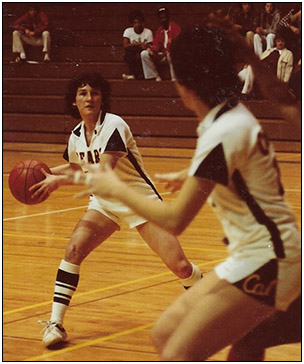
What the hell does this idiot know, I fume. All summer I’ve practiced five hours a day, lifted weights, and coached summer camps. I’ve done everything possible to earn my starting spot this fall. I don’t need another jerk annoying me.
Moments later, to my dismay, I discover that the idiot and I are on the same team. What a drag. More men are arriving, and they are already arguing who’s in line to play the winner of our full-court game. I decide I’ve played enough today, and I offer one of the new arrivals my spot.
“No, no, no,” interrupts the “ball-handling” idiot. “You were here first. Come on,” he challenges, “Play.”
I roll my eyes in disgust, but I walk back onto the court and we start playing. I ignore him.
Within a few plays, however, the idiot starts hitting 30-foot jump shots. Then he connects on some beautiful passes and makes a few incredible steals. He’s not tall or large, but quietly, smoothly, he begins to dominate the game.
And me? Well, I play my game and hold my own. I bring the ball up court and run the offense.
And I talk a lot. I can’t help it; it’s just the way I play. I don’t talk “trash,” like many men do: bragging, insulting each other’s masculinity, using verbal attacks to undermine opponents.
No, I’m the stereotypical floor general. I’ll call out, “outlet!” or “look down court” or “got help left” or whatever. And when someone does something well I always say, “nice shot” or “nice pass” or “great drive!” It’s not conscious; words just come out. I’ve tried remaining silent, but it’s futile; it’s like trying not to sneeze.
So soon, reluctantly at first, almost resentfully, I’m talking to the idiot. I don’t want to compliment him, but I can’t stop myself.
“Good pass,” I holler. “Good shot.”
What else can I say? It was a good shot. And it doesn’t take a rocket scientist to realize that this is the best player I’ve ever run with.
The game is close, and the idiot wins it for us with an amazingly long outside jumper. Usually the winners stay on the court, as they have won the right to take on the next challenging team, so I’m surprised when I notice him walk to the wall, gather his belongings, and head toward the exit.
My stomach turns. OK, he’s a jerk, but…everything possible to get a starting spot? Once he leaves, it’ll be too late. I swallow hard and sprint up to him.
“Excuse me,” I say, feeling my face redden, “but, uh…what did you mean about my ball handling?”
He does a double-take, then smiles, just ever so slightly. I rub the toe of one shoe up against my other ankle for what seems like hours but must be just a second or two.
“You want me to show you some practice drills?” he says finally.
Sure, I answer.
So we go over to an empty side court and work together for half-an-hour on drills: dribbling drills, shooting drills, defensive drills.
As we practice the gym fills up, but no one interrupts us or tries to move us off the empty court. That’s unheard of: nobody gets away with tying up an empty court when people are waiting. But I’m too busy concentrating on drills to give it much thought. When we finish I thank him for his time.
“Want to practice tomorrow?” he asks suddenly.
Sure, I say.
“Meet me at 1:00, at the end of my practice, and we can use the court there,” he says. “Do you know where the Oakland Coliseum is?”
It’s my turn to do a double-take.
S-sure, I stutter, and now I’m feeling like an idiot.
Then he adds, “I’ll be damned if you don’t remind me of me, talking like you do. You know how long it’s been since somebody told me, ‘nice shot, nice pass’? They all think I’m just supposed to know it already.”
After he leaves I stand there, stunned, as all my gym rat buddies trot over and surround me.
“Don’t you know who that is?” they ask.
No, I shake my head. They are appalled by my ignorance, yet they look jealous.
“That’s James Harris,” one guy said. “Yesterday he was traded to the Warriors.”
I stifle the urge to burst out laughing. Instead I take a deep breathe, hold it, exhale. Then I give them my best nonchalant shrug and start practicing my ball handling.
 How the Ball Bounced, by Nancy Nerenberg