
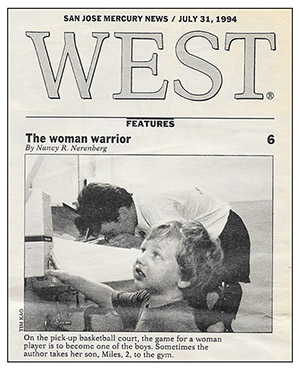
Published as “The Woman Warrior” on July 31, 1994
West Magazine, San Jose Mercury News
When I walk into the gym I look around and try to figure out who has “next game.” There is a full court game taking place on my left, and I see three or four men sitting on the sidelines. I approach the one wearing the orange shorts and a very worn, very sweaty Air Jordan T-shirt.
I ask, “You have next?”
Um-hm, he nods, avoiding eye contact.
“Can I run with you?” I continue. He hesitates. I know what he’s thinking. A girl. White. Short. Three strikes already. I should tell him I’m Jewish, too. Everyone knows Jews are lousy athletes.
He shrugs his shoulders, like: picking me up will doom his chance of winning but he doesn’t much give a damn if he loses again.
“Okay,” he says unenthusiastically.
It doesn’t bother me much. Not anymore. I’ve been doing this for a long time now–about 20 years. I’ve never been in this particular gym, but it feels so familiar, anyway. This is where I am most myself, most at ease. This is home. My husband will never understand; he suspects there is basically something wrong with me. But gym rats understand. In here, time stands still and for a few hours I am completely at peace.
It smells good in here. I love that familiar, homey smell of sweat. Once my friend Dolly came by to meet me at the gym. “It stinks in here!” she said. “Does it?” I replied, “Seems OK to me. It’s a gym.”
I begin to carefully pull on my two pairs of socks, stretching them out just perfect, so that when my shoes are laced there will be no tiny, little, irritating creases bunching up under my feet. Then I slowly tighten the laces, pulling them snug at every rung. It’s got to be done just right–not too tight, not too loose. You’d think I was preparing for a NASA lift-off.
As I go through this automatic routine, I am watching the court, trying to get a sense of the personality of this gym. Who is winning? How rough do they play? How much do they fight? To which men do the others consistently defer? Who cheats? Which males rely on the words “bitch” and “pussy” to insult other males? Usually within a few minutes, and certainly once I’ve been playing, the men seem to forget I’m there. Or maybe they forget I’m a woman. I’m not sure. I am let into this private male sub-culture, one to which most women are never privy. It fascinates me, so once my “invisibility” has been established, I play along.
I am continually amazed how men deal with men. I have this theory about sports: when we play we show how we truly are in life. On the court you are, in a sense, butt-naked out there. You can act arrogant, but in a clutch situation, when the game is on the line, we will notice when you choke. And when you hog the ball, it is obvious whether you do so because you are ignorant or inexperienced, which is unpleasant but acceptable, or whether you are simply selfish. When you call a foul, we know if it’s a legitimate call or if you’re just a crybaby. Do you make a bad pass and blame the person who couldn’t catch it?
I’ve seen, too many times to count, a male outplay another male and rub it in with one of the most typical gym insults: “Take that, you girl!” I’ve seen men lose their tempers when they don’t get their way and kick the ball so hard that it smashes up against the ceiling rafters. I’ve seen men pout and actually hold the ball hostage until the nine other players gave in to his will. Men have come to physical blows because they couldn’t agree who had the right to the next game. I’ve seen dirty fouls and heard bold-faced lies, all in order to win a game and control the court. In the gym, I witness a less sanitized, more savage side of males. I’d like to invite some of these guys’ girlfriends to watch through a one-way mirror sometime.
But there is a noble side as well. Most men play hard, giving themselves unselfishly to the game. Most play within their limits and make no apologies for it. There are the quiet players; they rarely speak and play so smoothly you don’t notice their actions, but they are consistently the ones who get the job done. There are the diplomats, who keep the peace and the pace of the game moving. There are natural leaders; within moments they can create a cohesive unit out of five strangers. And last is my favorite breed: those rare players who realize the true value of team play and are willing to give the ball up to a weaker player in a critical situation, even though they know it may cost them the game.
So every gym has its own personality, its own rituals, etiquette, hierarchy and rhythms. There are always two dances: that sometimes beautiful one on the court, and a bigger, more encompassing dance–the strange dance of the gym.
One shoe is laced, and I start adjusting the other. I’m starting to feel another familiar sensation. Adrenaline races through my body. Usually I start getting this feeling long before I enter the gym. It’s like a drug. Sometimes it starts first thing when I wake up in the morning, as soon as I realize that I get to play that day. In college, when I played guard for a Division I women’s team, and later when I played pro ball in France and Germany, this feeling could even start a few days before game day. But in those days I was too invested in my performance. There was always an element of pressure and anxiety: would I play poorly? was I good enough? Now I just feel sheer pleasure. As I get older, I find myself wishing that I had felt this passion for something else in my life: a job or career, for example. But it’s never happened.
I’ve finished lacing my shoes. My heart starts speeding up. This electrical current is urging me to jump up and start running around like an overstimulated six-year-old. But I don’t. Be cool, I tell myself. Take a deep breath. Follow my own rhythms. I’m just a short, thirty-nine-year-old, female basketball junkie.
I shove my socks down around my ankles. I pretend to ignore my teammates, the four men waiting on the sidelines. I know they’re watching me, waiting to see what kind of a handicap they’ve picked up for their squad.
See, here is how it works. Basically, with minor regional differences, you find this same system in any gym in the United States. It’s a cultural phenomenon; I saw it nowhere in Europe. And I seek out gyms in foreign lands just like my father, an optometrist, seeks out low-vision clinics wherever he travels in the world.
There is an implicit set of rules. For full court–the elite game of pick-up basketball–five play against five. If your squad wins, you win the right to hold the court. If you lose, you sit and wait your turn to play again. Someone on the sidelines or one of the “losers” announces (with witnesses), “I got next.” (Not “I’ve got next.” That would be grammatically incorrect in most gyms.) “Next” has the right to pick up his squad. For example, there could have been only that one guy with the orange shorts waiting, and he could’ve told me, “Sorry, I have 5.” It’s his right; it’s his “game.” It happens all the time. If that happens, I follow down the line of “nexts” until I find the last one, and I tell him, “I have it after you.” Then I have assured myself a game and the right to pick my own squad.
Sometimes it can be difficult to get picked up. One day, when I was first dating my husband Jens, I took him with me to the gym. Originally from East Germany, he had never even touched a basketball, let alone played the game. I wanted to share this part of myself with him; I wanted him to see me play. I was on the sidelines waiting for “next game” when one of the men on the court twisted his ankle and had to quit. The head of that squad came to the sidelines looking for a replacement.
“I’ll play,” I offered, springing up energetically.
“Naw, not you,” he said, continuing to scan the sidelines. Then he spotted Jens. “You want to play, man?”
Men can be cruel. I’ve seen men not get picked up because they were wearing red socks. You’ve got to know better than that. You can’t wear red socks and expect to get picked up. You might as well stamp “retard” on your forehead.
There are just certain traditions. White socks and high top basketball shoes are critical. The shoes should be black or white; any other color would be tacky. Recent trends indicate that it is a good idea to pull your shorts down onto your hips slightly, so your boxer shorts show. And it is best to push your two pairs of socks down in a bunch near your ankles. I don’t know why. There’s some anthropological explanation, certainly.
Anyway, if the gym is crowded, it is very important to pick up a strong, winning squad. If you lose, you sit and wait. If you win, you play (hold power, reign). And one more important thing: if your team has been winning, you can’t retire after a winning game. No, no, no. Even if you’ve played eight hours, have no fluid left in your body, just broke your ankle and your wife is delivering your first-born child at the hospital, you can’t quit until your squad is finally dethroned. That would be bad etiquette, pure and simple.
One day one of the guys came in upset and told us that his new girlfriend refused to see him anymore because he had shown up an hour late for a date.
“But I couldn’t leave the gym. My team was still winning,” he protested.
We nodded sympathetically. We’ve all been there. I have lied to baby-sitters and told them I was stuck in traffic to avoid admitting I was “stuck” in the gym.
I’ve finished my shoe and sock routine, so I stretch a bit and pick up a ball to warm up. That’s part of the ritual, too.
The game to my left has ended. One squad has won and looks smug. The losers limp off and the next team approaches. It reminds me of a stage crew changing the scenery between theater acts. I amble onto the court and choose the shortest man on the other squad to guard.
Someone says, “Shirts or skins? You’re skins, ha ha ha.” Manly chuckles. They always think they’ve said something so creative and original. I’ve heard it a million times. You see, one squad usually removes their shirts in order to keep straight who your teammates are. When I was younger I would give the man a look to let him know he was the biggest idiot ever to walk upright. Now I realize that probably most of the time they are actually just trying to be friendly and cut the ice. So I start pulling up my T-shirt off, as if to strip. I catch them off-guard, and they laugh. Somehow today (surprisingly) my team turns out to be shirts again. Well, I’ll be.
We inbound the ball. “Next” is hesitant to pass to me. So is “#2.” But “#3” and “4” know the game: they use my screens, run the breaks and hit me with the pass when I’m open. I’m a little nervous, but my first shot, a 12-foot banker, falls in. I relax and run back down court. A few trips down court later, I have the ball in the middle on the fast break. I fake right and pass left. “Next” doesn’t expect it; he’s taken his eyes off me. The textbook-perfect pass bounces off his nose and rolls forlornly out of bounds. Oh, well.
From the sidelines I hear, “Nice pass.” And this ritual, too, has repeated itself. The barriers fall. Now we can just play.
 How the Ball Bounced, by Nancy Nerenberg