
Published as “High Hopes” on August 18, 1996
West Magazine, San Jose Mercury News
When I walk into my bedroom I notice someone has mangled up the sheets and blankets and left them in a crumpled heap.
“Who’s been sleeping in my bed?” I sound like Mama Bear in Goldilocks.
My husband sits at the computer in a corner of the room, but I know he is innocent, as I see only a suspiciously small-body-ish heap of crumpled sheets. Besides, there’s another clue. As I straighten out the blankets, a child’s size 9, pink jelly shoe flips out of the bed.
“Oh, yea,” my husband mumbles without glancing back. “Miles was here for a while.”
“Where’s the other jelly?” I ask.
“I don’t know. He came in here with three of them.”
Recently Miles has become obsessed with jelly shoes, those ugly, cheap, tacky plastic sandals, generally marketed for $1.99 to the 2- to 5-year-old female consumer. Miles loves them, and given any opportunity, he will snatch a couple (or one, or three) from my daughter’s closet.
I’m not concerned with his jelly shoe obsession. He moves from one obsession to the next. He is four. At 18 months, he became obsessed with shooting basketballs through hoops. At the onset of this phase, we owned no hoop, so he coerced one of us to stand still and form a hoop with our rounded arms. That got old fast.
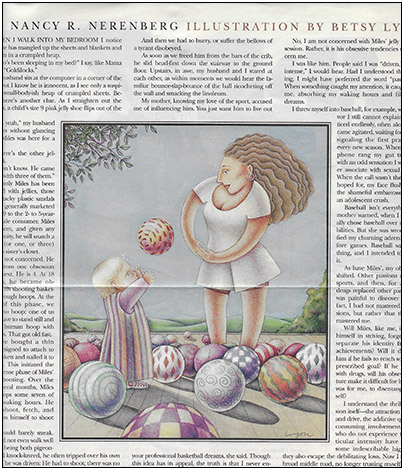
So we bought a thin hoop designed to attach to wastebaskets and nailed it to the wall. This initiated the most intense phase of Mile’s hoop shooting. I do not exaggerate when I state that over the next several months, Miles shot hoops about 7 of his 12 waking hours. He would shoot, fetch, and reposition himself to shoot again.
He could barely speak. He could not even walk well yet, and being both pigeon-toed and knock-kneed, he often tripped over his own feet. But he was driven: he had to shoot; there was no distracting him. I was not surprised that he improved quickly, and several times we had to raise the height of the hoop.
From his crib mornings we did not hear, “Mommy” or “Daddy,” or even, “Out!”
“Ba-ba-ball!” he would call. This first call was open and friendly, as if he might have said, “Hello. I’m awake.”
If we didn’t respond quickly enough, however, his second call became slightly more strident, more demanding: “BA-BA-BALL!”: “It’s time already. I’ve got to start shooting, damn it.”
Now we had to hurry because he became angry. We would hear the bellow of a tyrant disobeyed. Enraged, he’d scream, “BA-BA-BALL! “BA-BA-BALL!”
As soon as we freed him from the bars of the crib, he slid head-first down the stairway to the ground floor. Upstairs, in awe, my husband and I stared at each other, as within moments we would hear the familiar bounce slap bounce of the ball ricocheting off the wall and smacking the linoleum.
My mother, knowing my love of the sport, accused me of influencing him. You just want him to live out your professional basketball dreams, she said. Though her scenario has a certain appeal, the truth is that I never encouraged him to play. It was all his idea.
And several months later, just as dramatically as Miles had immersed himself in this activity, just as abruptly did he abandon it. One day he woke up and shot no more hoops.
He shifted his obsession to elephants, then motorcycles, then, in sequence: dinosaurs, Power Rangers, ballet slippers, wrestling, and, now, jelly shoes. I find it curious that my mother never accused me of pressuring him to become a paleontologist or an elephant trainer.
No, I am not concerned with Miles’ jelly shoe obsession. Rather, it is his obsessive tendencies which worry me. Already, at five, he reminds me more of myself than my 7-year-old daughter ever has.
I was like him. People said I was “driven.” She is “intense,” I would hear. Had I understood the meaning, I might have preferred the word “passionate.” When something caught my attention, it caught all of me, absorbing my wakeful hours and filling my dreams.
I threw myself into baseball, for example, with a fervor I could not, and still cannot, explain. I practiced endlessly, often alone. I became agitated, waiting for the call signaling the first practice of every new season. Whenever the phone rang my gut trembled with an odd sensation I would later associate with sexual arousal. When the call wasn’t the one I’d hoped for, my face flushed with the shameful embarrassment of an adolescent crush.
Baseball isn’t everything, my mother warned, when I continually chose it over responsibilities. But she was wrong, testified my churning adrenaline before games. Baseball was everything, and I intended to master it.
As with Miles, my obsessions shifted. Other passions replaced sports, and then, for a while, drugs replaced other passions. It was painful to discover that, in fact, I had not mastered my passions, but rather that they had mastered me.
Will Miles, like me, immerse himself in striving, forgetting to separate his identity from his achievements? Will it devastate him if he fails to reach some self-proscribed goal? If he dabbles with drugs, will his obsessive nature make it difficult for him, as it was for me, to disentangle himself?
I understand the thrill of passion itself—the attraction of thirst and drive, the addictive quality of consuming involvement. Those who do not experience this particular intensity have missed some indescribable highs. But they also escape the debilitating lows. Now I follow a broad middle road of moderation, no longer trusting myself to wander close to the dangerous soft shoulders of emotional extreme. Were it possible I would shield my son from certain shared aspects of our personalities.
In the meantime, I enter Miles’ bedroom and watch him snore. Digging under the sheets, my hands follow down the length of his knobby-kneed legs to find him still wearing, as expected, the missing jellies. Gently I wrest them from his soft, fat feet.
 How the Ball Bounced, by Nancy Nerenberg